Beginning around the fifth century, there was a gradual decline in the permanent diaconate in the Catholic church. From that time until the years just prior to the Second Vatican Council, the only men ordained as Deacons were seminarians who were completing the last year or so of graduate theological training, who received the order several months before priestly ordination.
Following the recommendations of the council ( in Lumen gentium, 29), in 1967 Pope Paul VI issued the Sacrum Diaconatus Ordinem, restoring the ancient practice of ordaining to the diaconate men who were not candidates for priestly ordination. These men are known as permanent Deacons in contrast to those continuing their formation, who were then called transitional Deacons. There is no sacramental difference between the two, however, as there is only one order of Deacons.
The permanent diaconate formation period in the Roman Catholic Church varies from diocese to diocese as it is determined by the local ordinary. But it usually entails a year of prayerful preparation, a four- or five-year training period that resembles a collegiate course of study, and a year of post-ordination formation as well as the need for lifelong continuing education credits. Diaconal candidates receive instruction in philosophy, theology, study of the Holy Scriptures (the Bible), homiletics, sacramental studies, evangelization, ecclesiology, counseling, and pastoral care and ministry before ordination. Although they are assigned to work in a parish by the diocesan bishop, once assigned, Deacons are under the supervision of the parish pastor. Unlike most clerics, permanent Deacons who also have a secular profession have no right to receive a salary for their ministry, but many dioceses opt to remunerate them anyway.
The ministry of the Deacon in the Roman Catholic Church is described as one of service in three areas: the Word, the Liturgy and Charity. The Deacon's ministry of the Word includes proclaiming the Gospel during the Mass, preaching and teaching. The Deacon's liturgical ministry includes various parts of the Mass proper to the Deacon, including being an ordinary minister of Holy Communion and the proper minister of the chalice when Holy Communion is administered under both kinds. The ministry of charity involves service to the poor and marginalized and working with parishioners to help them become more involved in such ministry. As clerics, Deacons are required to recite the Liturgy of the Hours. Deacons, like priests and bishops, are ordinary ministers of the sacrament of Baptism and can serve as the church's witness at the sacrament of Holy Matrimony, which the bride and groom administer to each other (though if the exchange of vows takes place in a wedding Mass, or Nuptial Mass, the Mass is celebrated by the priest and the Deacon acts as another witness). Deacons may preside at funeral rites not involving a Mass (e.g., the final commendation at the gravesite or the reception of the body at a service in the funeral home), and may assist the priest at the Requiem Mass. They can preside over various services such as Benediction of the Blessed Sacrament, and they may give certain blessings. They cannot hear confession and give absolution, anoint the sick, or celebrate Mass.
At Mass, the Deacon is the ordinary minister of the proclamation of the Gospel (in fact, a priest, bishop, or even the Pope should not proclaim the Gospel if a Deacon is present) and of Holy Communion (primarily, of the Precious Blood). As ordained clerics, and if granted faculties by their bishops, Deacons may preach the homily at a public Mass, unless the priest celebrant retains that ministry to himself at a given Mass.
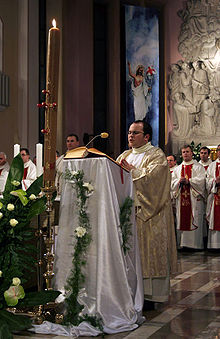
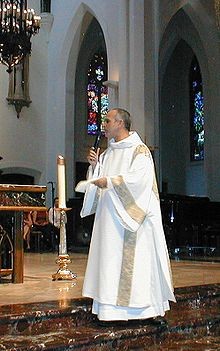
The vestment most particularly associated with the Western Rite Catholic Deacon are the Alb, stole and Dalmatic. Deacons, like priests and bishops, must wear their albs and stoles; Deacons place the stole over their left shoulder and it hangs across to their right side, while priests and bishops wear it around their necks. The dalmatic, a vestment especially associated with the Deacon, is worn during the celebration of the Mass and other liturgical functions; its use is more liberally applied than the corresponding vestment of the priest, the Chasuble. At certain major celebrations, such as ordinations, the diocesan bishop wears a dalmatic under his chasuble.
Permanent Deacons often serve in parish or other ministry as their time permits, since they typically have other full-time employment. They may also act as parish administrators (C. 217 of the Code of Canon Law). With the passage of time, more and more Deacons are serving in full-time ministries in parishes, hospitals, prisons, and in diocesan positions. Deacons often work directly in ministry to the marginalized inside and outside the church: the poor, the sick, the hungry, the imprisoned.
The transitional diaconate is to be conferred on seminarians (continuing to the priesthood) no sooner than 23 years of age (C. 1031 of the Code of Canon Law). The permanent diaconate can be conferred on single men 25 or older, and on married men 35 or older, but an older age can be required by the episcopal conference. If a married Deacon is widowed, he must maintain the celibate state. Under some very rare circumstances, however, Deacons who have been widowed can receive permission to remarry. This is most commonly done when the Deacon is left as a single father. In some cases, a widowed Deacon will seek priestly ordination, especially if his children are grown.
The wife of a permanent Deacon may be sometimes considered a partner in his ordained ministry. In many dioceses, the wife of the diaconal candidate undertakes the same education and training her husband does.
A permanent Deacon is not styled "Father" as a priest would be, but as "Deacon", (in Spanish, "Diácono") abbreviated variously as "Dn." or "Dcn." This preferred method of address is stated in the 2005 document of the United States Conference of Catholic Bishops, National Directory for the Formation, Ministry and Life of Permanent Deacons in the United States. The proper address in written correspondence for all Deacons of the Latin (Roman Rite) Catholic Church is "Rev. Mr.". "Rev. Mr.", however, is more often used to indicate a transitional Deacon (i.e., preparing for ordination to the priesthood ) or one who belongs to a religious institute, while Rev. Deacon is used as the honorific for permanent Deacons in many dioceses (e.g. Rev. Deacon John Smith, or Deacon John Smith). The decision as to whether Deacons wear the Roman Collar as street attire is left to the discretion of each bishop for his own diocese. Where clerical garb is approved by the bishop, the deacon can choose to wear or not wear the "collar". Where it is not permitted, the deacon must wear secular clothing. It is becoming more common to see deacons wearing a clerical suit especially in prisons and jails.
Deacons, like seminarians, religious, and the two other orders, Bishops and Priests, recite the Liturgy of the Hours; however, Deacons, if they are obliged to do so, are usually only required to participate in Morning and Evening Prayer.
In solemn Masses today and more so in older Rites of the Mass, one deacon will serve as the Deacon of the Word (proclaiming the Gospel and the Kyrie, and some other parts), and the Deacon of the Eucharist, who assists the Priest during the Liturgy of the Eucharist.
In addition to reading the Gospel and assisting in the administration of Holy Communion, the Deacon censes the icons and people, calls the people to prayer, leads the litanies, and has a role in the dialogue of the Anaphora. In keeping with Eastern tradition, he is not permitted to perform any Sacred Mysteries (Sacraments) on his own, except for Baptism in extremis (in danger of death), conditions under which anyone, including the laity, may baptize. When assisting at a normal baptism, it is often the Deacon who goes down into the water with the one being baptized (Acts 8:38).
A Protodeacon (Greek: πρωτοδιάκονος: protodiakonos, "first Deacon") is a distinction of honor awarded to senior Deacons, usually serving on the staff of the diocesan bishop. An Archdeacon is similar, but is among the monastic clergy. Protodeacons and Archdeacons use a double-length orarion even if it is not the local tradition for all Deacons to use it. In the Slavic tradition a Deacon may be awarded the doubled-orarion even if he is not a Protodeacon or Archdeacon.