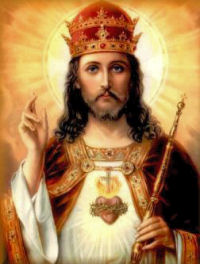
Jesus Christ the same yesterday,
today and forever. —
Hebrews 13:8 |
ORDINARY TIME
What is Ordinary Time ?
The rhythm of the liturgical seasons reflects the
rhythm of life — with its celebrations of anniversaries and its seasons of quiet growth and maturing.
Ordinary Time, meaning ordered or numbered time,
is celebrated in two segments: from the Monday following the Baptism of
Our Lord up to Ash Wednesday; and from Pentecost Monday to the First Sunday
of Advent. This makes it the largest season of the Liturgical Year.
In vestments usually green, the color of hope and
growth, the Church counts the thirty-three or thirty-four Sundays of Ordinary
Time, inviting her children to meditate upon the whole mystery of Christ
– his life, miracles and teachings – in the light of his Resurrection.
If the faithful are to mature in the spiritual life
and increase in faith, they must descend the great mountain peaks of Easter
and Christmas in order to "pasture" in the vast verdant meadows of tempus per
annum, or Ordinary Time.
Sunday by Sunday, the Pilgrim Church marks her
journey through the tempus per annum as she processes through time
toward eternity.
|
"Lord, to whom shall
we go?
You have the words of eternal life."
— John 6:68
|
Scripture and the
Liturgy
In her revision of the Liturgy, the
Church has sought to reestablish the preeminence of Sunday, that feast
day par excellence, over every other feast day.
Recognizing, too, that Our Lord is really present
when Sacred Scripture is read during the Liturgy, she has opened up the
"treasures of the bible so that richer fare may be provided for the faithful
at the table of God's Word."
To encourage her children to have a "warm and living
love for Scripture, the Church has enlarged the Sunday Lectionary so
that the various books of the New Testaments are read roughly from beginning
to end over a period of weeks, and the synoptic Gospels are read in a
3 year cycle Year A – Matthew; Year B – Mark; Year C –
Luke.
Old Testament readings and Psalms are chosen to
correspond to the Gospel passages and to bring out the fulfillment of
the Old Testament in the New. The revised weekday lectionary for Ordinary
Time complements the Sunday lectionary with its 2-year cycle of readings
presenting all the major portions of the Bible, and a 1-year cycle for
the Gospels of Matthew, Mark and Luke.
|
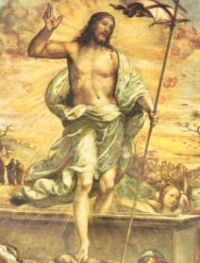
"Lord of time; he
is its beginning and its end; every year, every day and every moment
are embraced by his Incarnation and resurrection, and thus become part
of the 'fullness of time'."
Tertio Millennio Adveniente
|
The Easter Mystery
Celebrated in Ordinary Time
Parents are challenged to keep the
Easter mystery alive
in their families throughout the season of Ordinary Time; to focus on
the mysteries of Christ which the Church sets before them in the weekly
Mass readings and to apply those readings to their daily lives.
In this way, faith will bear fruit
within their homes, intensifying through the fertile weeks of Ordinary
time until its conclusion, the crowning feast of Christ the King.
Joyful Expectation at Year's
End
At the close of every
Liturgical Year may we look forward with renewed hope to Christ's coming
again in glory to reign as Lord forever. For it is Jesus Christ we seek
when we strive to live the Liturgical Year with the Church. He is the
"Lord of time; he is its beginning and its end; every year, every day
and every moment are embraced by his Incarnation and resurrection, and
thus become part of the 'fullness of time'.
|
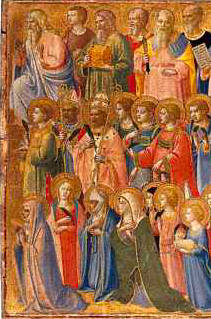
"...there was an enormous
crowd...
They were from every race, tribe,
nation, and language...."
— Rev. 7:9
|
Feast Days
While insisting that the feasts that commemorate the mysteries
of salvation take precedence, the Church nonetheless includes the celebration
of the feast days of the Blessed Virgin Mary and of the saints in the
liturgical calendar.
"By inserting into the annual cycle the commemoration
of the martyrs and other saints on the occasion of their anniversaries,
'the Church proclaims the Easter mystery of the saints who suffered with
Christ and with him are now glorified.' (Sacrosanctum Concilium,
102) When celebrated in the true spirit of the liturgy, the commemoration
of the saints does not obscure the centrality of Christ, but on the contrary
extols it…"
"The intrinsic relationship between the glory
of the saints and that of Christ is built into the very arrangement of
the liturgical year, and is expressed most eloquently in the fundamental
and sovereign character of Sunday as the Lord's Day."
[Advent]
[Christmas]
[Lent]
[Holy Week]
[Easter Season]
[Seasons] [Menu]
|
|