In the Sacrament of Holy Orders, or Ordination, the priest being ordained vows to lead other Catholics by bringing them the sacraments (especially the Eucharist), by proclaiming the Gospel, and by providing other means to holiness.
In and through His humanity, Christ exercised the triple offices of prophet, priest, and king. All the baptized share these offices of Christ. However, the baptismal offices need to be activated by the hierarchical offices. A deacon activates the kingly office. A priest, most properly, activates the priestly office. A bishop, most properly, activates the prophetic office. The hierarchical offices are conferred by a bishop on individual men through the sacrament of Holy Orders. A bishop is the minister of Holy Orders. Since all three orders -deacon, priest, and bishop-are ultimately directed towards the Eucharist, i.e., towards the self-gift to God of Christ the priest, the sacrament of Holy Orders is an expression of Christ's priesthood, even in the ordination of deacons and bishops. A deacon's kingly service, i.e., His love, flows directly from Christ's love expressed in the Eucharist. As Christ expressed His love for everyone on the cross, so a deacon expresses love and encourages others to love through his kingly office. A bishop's prophetic teaching of the truth flows directly from Christ, the Truth, present in the Eucharist. Not only do the ministries of a deacon and a bishop flow from the Eucharist, they are also directed towards it. A deacon activates the kingly expression of love that prepares people to express their love for Christ in the Eucharist. The teaching of a bishop draws people to Christ present in the Eucharist.
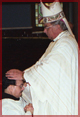
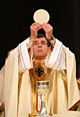
The bishop, acting in the person of Christ~ ordains a man a deacon, priest, or bishop through the imposition of hands on the head of the candidate and by the recitation of a prayer. For example, the prayer for the ordination of priests reads: "Almighty Father, grant to these servants of Yours the dignity of the priesthood. Renew within them the Spirit of holiness. As co-workers with the order of bishops may they be faithful to the ministry that they receive from You, Lord God, and be to others a model of right conduct." The sacrament of Holy Orders itself was instituted by Christ at the Last Supper, the night before He died. With the words, "Do this in remembrance of Me," Christ gave the gift of Holy Orders to the Apostles. As Pope John Paul II wrote to the priests of the world on Holy Thursday of 1986, "Here we are again, about to celebrate Holy Thursday, the day on which Christ Jesus instituted the Eucharist and at the same time our ministerial priesthood [hierarchical offices]." Through ordination, a man becomes another Christ and when the ordained man celebrates the sacraments, he acts "in the Person of Christ." In other words, in the ordination ceremony, the one ordained is touched by Christ and made capable of acting in His Person. For example, in speaking of the connection between the ordained priest and the Eucharist, John Paul states that Christ "calls some and enables them [through ordination] to be ministers of His own sacramental sacrifice, the Eucharist."
By loving us and God in the sacrament of Holy Orders, Christ reveals how we should love. Through the sacrament of Holy Orders, the Church, i.e., Christ, establishes the hierarchical offices that exist for the baptized. In other words, a deacon, priest, or bishop is a man who works for others. A deacon, priest, or bishop loves others permanently and limitlessly. An ordained man remains a deacon, priest, or bishop forever. Further, he gives all that he has, i.e., Christ's offices conferred by ordination, to the baptized. As the sacrament of Matrimony is a confirmation of the mandate in Genesis to form a familial communion of persons, so the sacrament of Holy Orders confirms the mandate in Genesis to form a worker communion of persons. Through the sacrament of Holy Orders, Christ reveals that we all should strive to love all men and women in the worker communion of persons.
The grace given in the sacrament of Holy Orders transfers one of the hierarchical offices of Christ to those ordained. The imposition of hands and the prayers that are said signify a gift from the one imposing hands to the one who receives the imposition of hands. In the sacrament, the one ordained actually receives a gift: one of Christ's hierarchical offices. The imposition of hands commonly signifies a wish to give a certain capability or power. For example, a father might embrace a son or daughter about to drive the family car for the first time. If it were possible, the father might like to transfer all his driving skills to his child through his fatherly embrace. Such a transfer is not possible for a father. However, in the sacrament of Holy Orders, the sign causes what it signifies, and it actually transfers one of the hierarchical offices of Christ to the ordained. With "the blessing of the Holy Spirit and the grace and power of the priesthood," the ordained man will exercise his priesthood with the love that it requires.